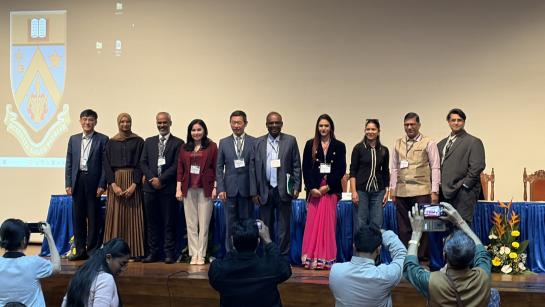

From 27 to 29 July 2026, the EU-China Higher Education Research Center (ECHE) co-convened the International Symposium on Higher Education Leadership, Innovation and Capacity Development in Mauritius. The symposium was organised in collaboration with the Ministry of Tertiary Education, Science and Research of Mauritius, the Mauritius Institute of Education, the University of Mauritius, the Open University of Mauritius, the UNESCO Research Centre at Zhejiang University, the UNESCO Chair and EE-Net China Chapter, the Swedish International Capacity Development Academy (SICDA), and the LEAD Academic Network.
The three-day multi-stakeholder gathering welcomed more than 200 local and international participants from 36 countries, representing 63 universities and higher education institutions. Through keynote addresses, round-table discussions and parallel sessions, participants engaged in lively exchanges across six interconnected themes: higher education leadership, research and innovation, entrepreneurship education, capacity development, artificial intelligence, and micro-credentials.
Connecting policy, diplomacy and academic leadership
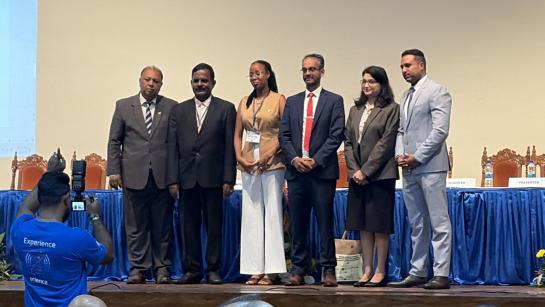
The opening ceremony reflected the symposium’s ambition to connect higher education with public policy, diplomacy and international cooperation. It was attended by the Honourable Dhananjay Ramful, Minister of Foreign Affairs, Regional Integration and International Trade; Dr the Honourable Kaviraj Sharma Sukon, Minister of Tertiary Education, Science and Research; the Honourable Nitish Beejan, Member of Parliament; and invited representatives of the diplomatic corps, including Her Excellency Dr Huang Shifang, Ambassador of the People’s Republic of China to Mauritius.
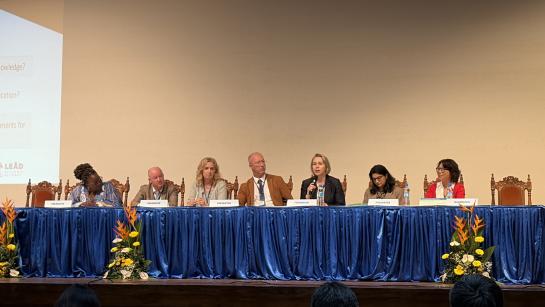
In her opening keynote, Professor Chang Zhu presented the work of ECHE and the LEAD Academic Network in fostering networked learning and international research on academic leadership development and university governance. She subsequently moderated the round table on educational leadership, which brought international perspectives to questions of knowledge, responsibility, institutional change and the evolving role of university leaders in the age of generative AI.
The discussion repeatedly returned to a human-centred principle. Although AI can support the creation, organisation and application of knowledge, it cannot replace the situated, relational and embodied dimensions of teaching and learning. Participants therefore emphasised the need for universities to combine technological innovation with critical thinking, ethical responsibility and sustained professional development.
ECHE research across institutional and learner perspectives
ECHE researchers contributed a connected portfolio of studies examining how universities can respond to international, organisational and technological change.
Dr Zhengwen Qi, Laura Pizzirani and Professor Chang Zhu presented their study on how organisational dimensions shape leadership for internationalisation at universities. Dr Yujie Xue and Professor Chang Zhu presented findings from a survey of 1,111 students examining the use of generative AI in Tanzanian higher education. A further contribution by Dr Zhao Cheng and Professor Chang Zhu introduced the CAIR framework for responsible AI integration in higher education.
These ECHE contributions connected different levels of higher education transformation, providing a powerful overview of how HEIs can enhance their organisational strategy and leadership to improve institutional governance, educator development and students’ everyday learning experiences.
A broad VUB contribution
The wider contribution from Vrije Universiteit Brussel reinforced the symposium’s interdisciplinary character. Anthony Antoine, Executive Director of the Brussels School of Governance, examined the increasingly important relationship between generative AI and university governance. Professor Karen François discussed leadership and institutional responsibility in doctoral education. Drawing on the VUB experience, she examined the transition from the traditional supervisor–doctoral researcher relationship towards a more comprehensive support system involving supervisory teams, doctoral schools, professional development and career preparation.
These contributions extended the symposium’s discussions beyond technology itself, connecting AI governance with academic leadership, researcher development and universities’ broader institutional responsibilities.
Building responsible and sustainable university partnerships
Across the plenary sessions, round tables and parallel presentations, participants agreed that universities need more than technical solutions to navigate rapid change. Responsible progress also requires critical thinking, ethical guidance, continuous professional learning, institutional trust and the ability to collaborate across disciplinary, institutional and national boundaries. This perspective closely reflects ECHE’s commitment to creating equitable spaces for dialogue and collaboration among higher education communities in Europe, China, Africa and beyond.
For ECHE, the Mauritius symposium provided an important platform for sharing research, learning from diverse institutional experiences and strengthening dialogue among university leaders, policymakers, researchers, educators and students. It also demonstrated the value of connecting rigorous empirical research with international and cross-sectoral exchange. At a time of geopolitical uncertainty and accelerating technological transformation, such collaboration is essential to developing forms of internationalisation, academic leadership and AI integration that are responsible, equitable and sustainable.